

While we use body weight as an important measure of progress, natural fluctuations mean that it can never tell the whole story. That’s why at U.P. we use multiple measures to track progression, including tape measure readings.
By taking multiple measures, you can have peace of mind that your decisions are based on facts and evidence, rather than a brief snapshot in time. Read on to learn everything you need to know about taking circumference measurements.
Key takeaways
- Invest in a high-quality tape measure that won’t stretch and use the same tape measure every time.
- Ask a friend or family member to take the measurements once a week.
- Men should wear shorts with no top, and women should wear shorts and a sports bra.
- Try and keep the conditions the same each time, e.g., food, water, time of day.
Take three measures of each site and use the average of all three.
Record measurements for each site: waist, upper thigh, shoulder, calf, hip, upper arm, neck.
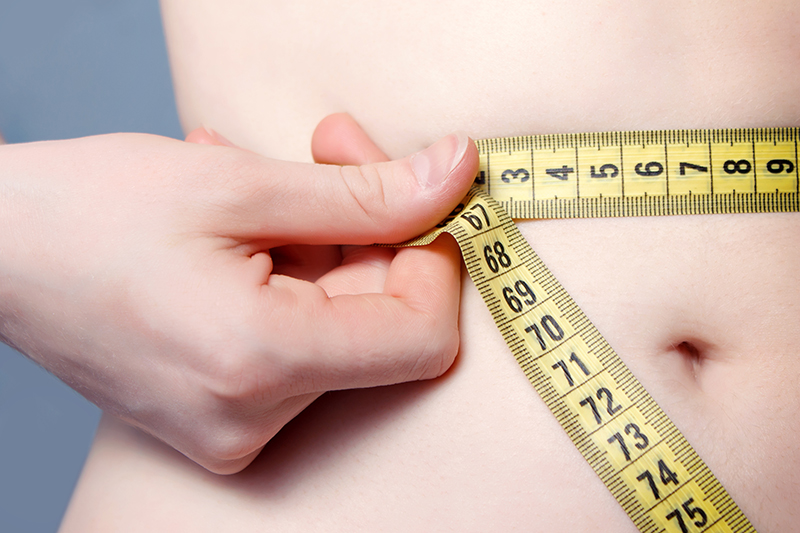
What you need
- Tape measure calibrated in centimetres with millimetre markings. Use the same tape measure every time.
- A friend or family member to help take the measurements.
- We recommend that men wear shorts and no top, and women wear shorts and a sports bra.
- Frequency and timing
- We have highlighted the sites you need to measure on the diagram below, which differ slightly for men and women.
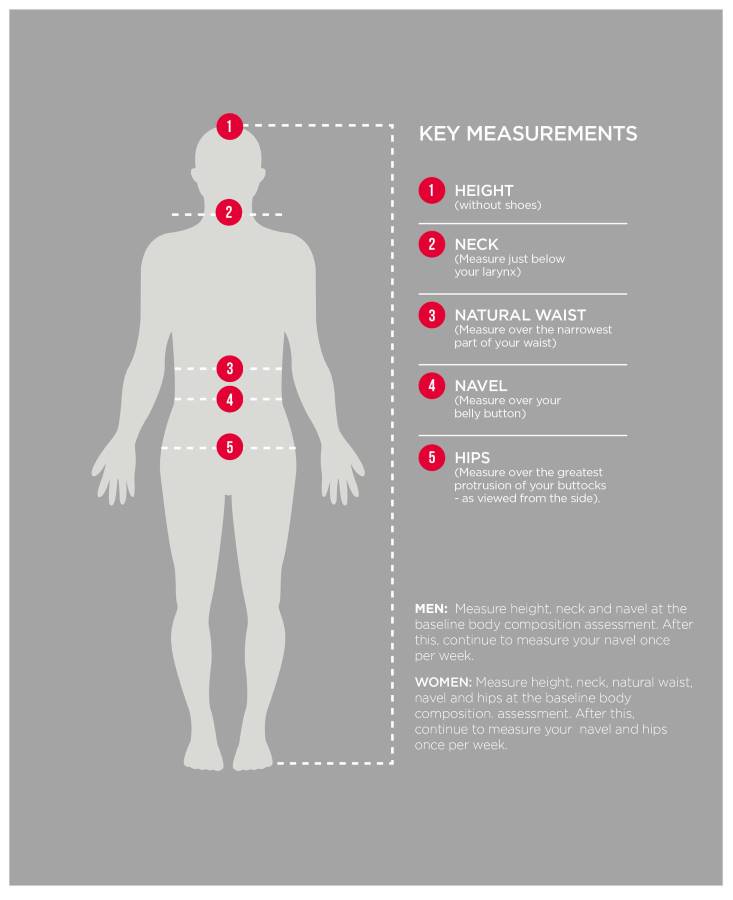
MEN: Measure your height, neck and navel at the baseline body composition assessment. After this, continue to measure your navel once per week.
WOMEN: Measure your height, neck, natural waist, navel and hips at the baseline body composition assessment. After this, continue to measure your navel and hips once per week.
Record first thing in the morning, after using the bathroom and before eating or drinking anything (where possible).
If you measure later in the day, make a note of the time and number of meals eaten.
Aim to measure at a consistent time and always before training.
Do not take measurements after training or sitting in a sauna/shower, as exercise, heat and warm water can affect your results.
Trainer Tips:
The two sites we are most interested in for ongoing progress assessment are the navel and hips.
Men typically hold most of their body fat on their upper body, specifically around their stomach. In contrast, women tend to carry more body fat on their lower body, specifically on their hips and thighs.
How to measure
When you take circumference measurements, make sure to:
- Stand upright with your feet shoulder-width apart and arms hanging by your sides.
- Once the tape measure is in position, breathe normally.
- The person assisting you in taking the measurements should make sure to:
- When positioning the tape measure, try to minimise any gaps between the tape and body surface. But do not hold the tape measure too tight as skin compression produces artificially low readings.
- Continuous contact is not always possible on some measurement sites, e.g., across the lower back when measuring the navel.
- If measuring over clothing, e.g., shorts, apply enough tension to minimise the effect of the clothing.
- Make sure the tape measure is level and not twisted.
- When reading the tape measure, take the reading from eye level to prevent parallax errors.
- Hold the tape measure in place for a few full breaths and then read the measurement at the end of a normal exhalation.
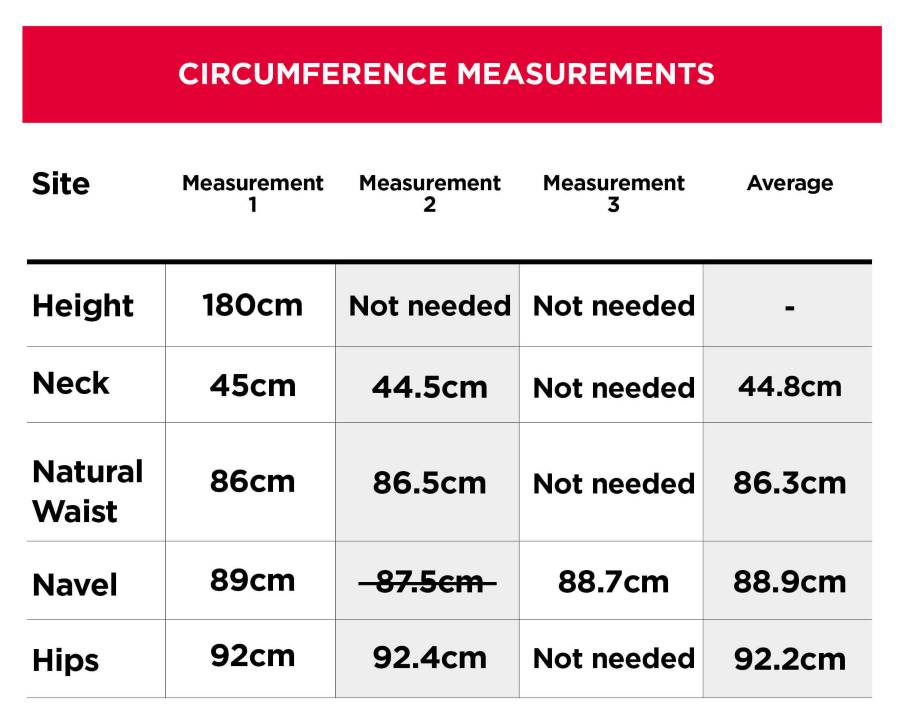
- Record measurements to the nearest 0.1 cm, e.g., 85.6cm.
- Perform two measurements at each site and calculate the average. To do this, add the measurements together and divide them by the total number of readings.
- If the two measurements differ by more than 0.5 cm, take an extra measurement and calculate the average of the two closest readings.
Trainer Tips:
You should read the measurements at eye level to avoid parallax errors. A parallax error occurs when you read a different value on a measuring device depending on your viewing angle.
For example, looking down at your protein shaker and trying to fill it up to 500ml versus holding it at eye level.
Make sure the tape measure is level and not twisted when taking the measurements. From experience, all sites need at least some adjustment.

